
Brazing
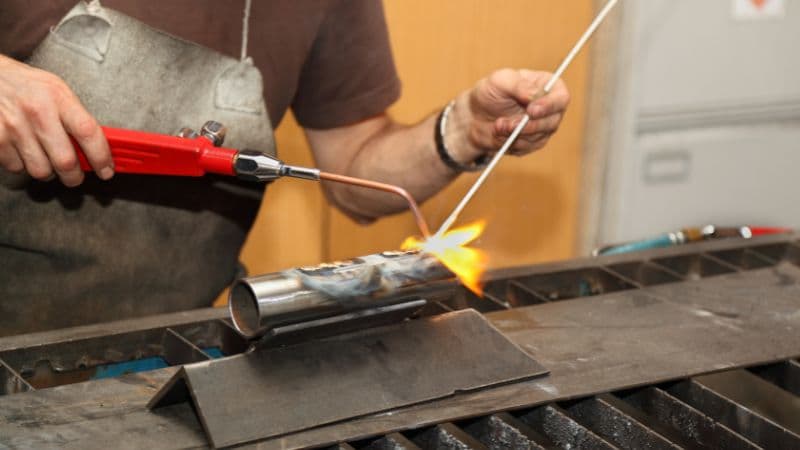
Brazing is the joining of metals with a filler metal that melts above 450 °C but below the melting point of the parts, which do not melt. It is used in heat exchangers, cutting tools, and piping. Below, we explain how it works and how it differs from welding.
What Is Brazing?
Brazing is a metal-joining process in which a filler material, known as filler metal or brazing alloy, is heated to a temperature above its melting point but below that of the base metals to be joined.
This filler metal is applied to the surfaces of the metal parts to be joined. As the filler metal melts and flows between the surfaces, it bonds firmly to them after cooling, creating a strong, durable joint.
How Does the Brazing Process Work?
The brazing process begins with preparing the surfaces of the parts to be joined. This involves removing any contaminants, such as oxides, that could impair adhesion. The filler metal is then applied to the surfaces of the parts, often in the form of a powder alloy, strip, or paste.
The next step is heating. The filler metal is heated until it reaches its melting temperature, which is lower than that of the base metals. As the filler metal melts, it flows between the parts to be joined, filling any gaps or clearances. Capillary action is an important phenomenon in this process, as it helps the filler metal spread evenly and bond to the surfaces.
As the filler metal cools and solidifies, it forms a solid joint between the metal parts. The result is a strong, durable joint that maintains its mechanical and thermal properties.
Applications of Brazing
Brazing is widely used in a variety of industries because of its ability to join different metals, even dissimilar ones, effectively. Some notable examples of brazing applications include:
- Automotive Industry: Brazing is used in the manufacture of radiators, heat exchangers, and exhaust systems, where it is essential to join different types of metals, such as aluminum and copper.
- Aerospace Industry: Critical components, such as aircraft engines and fuel systems, often involve brazing to join high-strength materials.
- Refrigeration Industry: Brazing is used in the production of heat exchangers and evaporators for refrigeration and air conditioning systems.
- Jewelry Industry: Brazing is used in jewelry production, allowing precious metals to be joined.
- Electronics Industry: Brazing is used in the assembly of electronic components, such as printed circuit boards, where precision and durability are essential.
The Future of Brazing in Industry
Brazing continues to play a vital role in manufacturing and engineering, and its future is promising. With the evolution of technology and the search for more efficient and sustainable solutions, brazing is adapting to the demands of modern industry.
- Technological Innovations: Brazing is benefiting from advances in heating technologies, such as induction furnaces and laser systems, which offer greater temperature control and precision.
- Advanced Materials: The development of high-strength brazing alloys with lower melting points is expanding the possibilities of brazing in high-temperature applications.
- Sustainability: Brazing is an environmentally friendly alternative, as it requires less heat and produces less waste compared to traditional welding processes.
- Industry 4.0 Integration: Brazing is adapting to Industry 4.0, with the use of sensors and automation to monitor and control the process in real time.
Steps of the Brazing Process
The brazing process can be divided into several steps:
- Surface Preparation: Removal of oxides, grease, and other impurities from the surfaces of the metal parts.
- Application of the Brazing Metal: Application of the brazing metal to the surfaces of the parts to be joined.
- Heating: Heating of the parts until the brazing metal reaches its melting temperature.
- Melting and Distribution: The brazing metal melts and flows between the surfaces of the parts, filling any gaps.
- Cooling and Solidification: The brazing metal cools and solidifies, creating a solid joint between the parts.
- Finishing: Excess brazing metal can be removed, and the finished parts can be machined, polished, or heat treated as needed.
How Does Simulation Software Make a Difference in the Brazing Process?
The incorporation of simulation software, together with 3D scanning and reverse engineering techniques, is revolutionizing the brazing process. These tools allow engineers to predict material behavior during brazing, identifying areas of stress, deformation, and potential defects.
3D scanning is used to digitize real parts and create
accurate virtual models, which are essential for optimizing the process before production. This saves time and resources, reducing the need for testing and adjustments in actual production.
Reverse engineering plays an important role in creating virtual models from existing parts, enabling the reproduction and improvement of components already in use. This is particularly valuable in spare parts manufacturing and in optimizing old parts.
The simulation software, in turn, allows engineers to test different scenarios and variables of the brazing process, making sure the joint is formed accurately and without defects. This not only increases the quality of the final product, but also reduces waste of material and resources, making the brazing process more efficient and economical.