
Hexagon (MSC Software)
Simufact Welding
Welding simulation: distortion, residual stress, and clamps defined before the fixture.
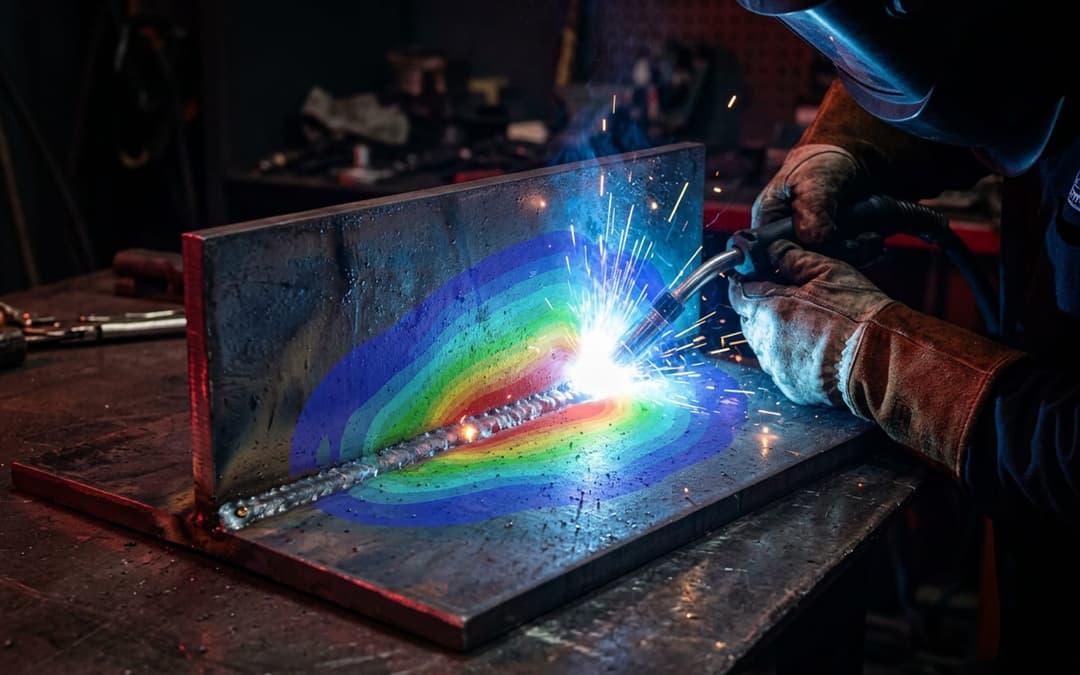
Simufact Welding is welding simulation software that predicts distortion and residual stress before the first part is welded. It calculates microstructures in the heat-affected zone, flags risks such as thermal cracking, and evaluates clamp position and quantity. Technosim resells, implements, and trains your team in Brazil.
Highlights
Distortion at the design stage
You identify distortions that are critical for assembly, such as bowing and gaps, before a welded assembly even exists.
Residual stress by scenario
Compare residual stress and distortion in different welding scenarios on the computer.
Microstructure in the HAZ
The calculation evaluates the effect of heat on hardness and metallic phases in the affected zone.
Clamps before the fixture
A dedicated tool evaluates clamp location and quantity for cooling.
Virtual try-out
Welding tests on the computer, with fewer parts and consumables wasted on trials.
Spot welding and DED
Covers most joining processes, including spot welding and Directed Energy Deposition.
Simufact Welding: what welding simulation is
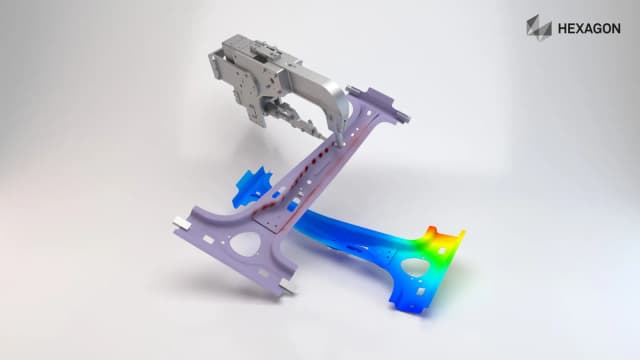
Simufact Welding is welding simulation software. It calculates distortion and residual stress, evaluates the microstructures formed in the heat-affected zone, and predicts possible defects, such as thermal cracking. The simulation covers the entire material, not just the weld line.
The software covers most joining processes, including spot welding and Directed Energy Deposition (DED), and includes a dedicated tool for the position and quantity of clamps that hold the part during cooling.
The question it answers is straightforward: with these parameters, this sequence, and this fixturing, how will the assembly turn out once it cools? For you, the answer arrives at the design stage, when changing a parameter costs a new scenario in the software rather than a rebuilt fixture.
What problem Simufact Welding solves
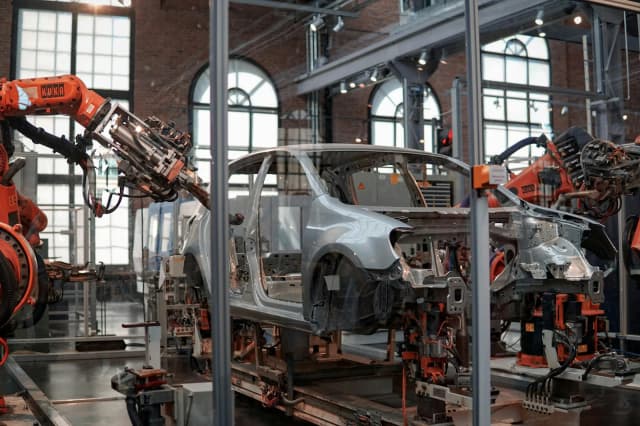
The typical problem is the welded assembly that does not fit together. The part comes out of welding warped, with bowing or gaps beyond what the assembly accepts, and the fix becomes straightening, extra machining, or a new fixture. Each attempt consumes parts, consumables, welder hours, and time.
The software lets you identify these critical distortions during design, evaluate the best welding process, and test variations without welding anything. The target audience is process engineering, fixture design, and quality teams in companies that weld structural assemblies, sheet metal, and assembly components.
When the assembly is expensive or repeats in batches, every adjustment cycle you avoid weighs on the final cost. For the buyer, the decision question is how much each physical welding try-out costs your company today.
How distortion and residual stress simulation works
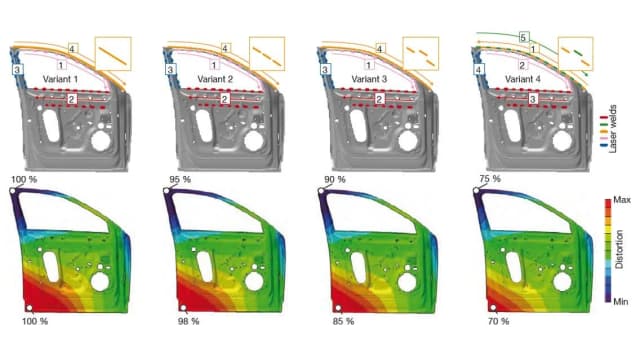
Welding heats a small region to very high temperatures while the surrounding metal stays cold. The hot zone tries to expand and is restrained by its surroundings, yields plastically, and contracts as it cools. This restrained contraction leaves residual stress and deforms the part.
Simufact Welding models this thermal and mechanical cycle across the entire material. With it, you examine behavior at each stage of welding and evaluate residual stress and distortion in various scenarios. Because the simulation follows the thermal cycle, it also calculates the effect of heat on hardness and metallic phases in the affected zone, which indicates the risk of thermal cracking.
The result is a map of the deformed assembly and the stresses, used to decide parameters before welding.
Welding sequence and fixturing: what the scenario lets you compare
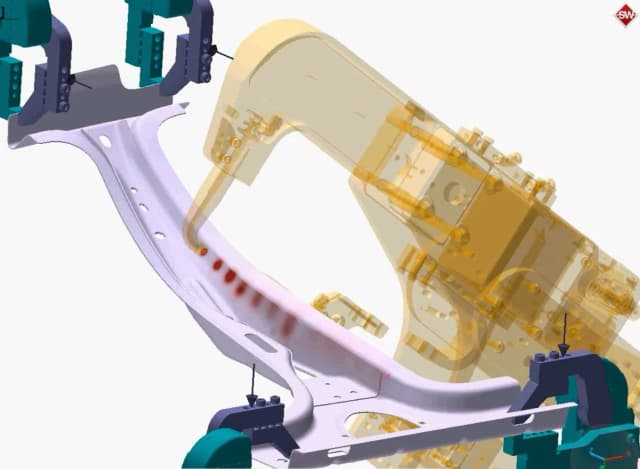
In welding simulation, two factors weigh heavily: the order in which the beads are made and how the part is held. Each bead restrains the next, so the sequence changes the final distortion. Fixturing acts as a counterweight, since clamps reduce warping during welding but lock in contraction and can increase residual stress when released.
That is why clamp evaluation is a specific tool in the software: it evaluates the location and quantity of clamps that hold the part during cooling, before the fixture is finalized. These are general welding simulation concepts, and Technosim confirms how the module and the license cover your case.
The consequence for you is deciding on the fixture with data, rather than building it and correcting it later.
Real limits of Simufact Welding
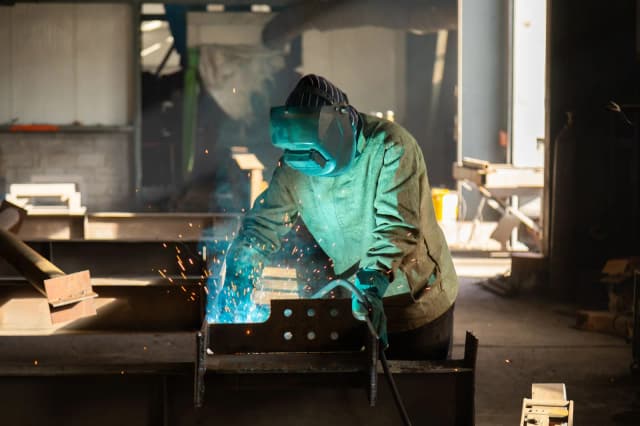
The result depends on the input data: material properties as a function of temperature, process parameters, assembly geometry, and clamping conditions. Inaccurate data produces an inaccurate prediction. That is why the first case should be calibrated with an assembly that has already been welded, comparing the measured distortion with the calculated one. 3D scanning of the real part, for example, serves this comparison.
Simulation also reduces, but does not eliminate, physical testing. Critical assemblies still require validation.
Another limit is scope: the software simulates welding and joining. It does not deal with forming sheet metal or quoting stamped parts. For you, the gain comes from using the tool where distortion and residual stress are costly, and not on every welded joint in the factory.
When Simufact Welding is not the best choice and what to use instead
If your problem is forming the part, that is, forging, sheet metal stamping, or rolling, the right product is Simufact Forming. It simulates material flow and load on the tool, not the thermal cycle of a weld.
If the goal is to quickly quote a stamped part, with blank and tooling cost, the path is Forming Suite.
If welding is rare and the assembly is simple and cheap to redo, a physical try-out may cost less than the license and the modeling time. And to measure the welded part once it is finished and compare it with the CAD, Geomagic Control X performs that inspection, and it can feed the calibration of your model. Describe your assembly, and Technosim will recommend which product answers your first question.
Simufact Welding implementation in practice
Implementation begins with understanding your welded assembly: welding process, materials, part size, current sequence, and the distortion problem that shows up. Technosim defines the license model with you, which may go through MSC One, with tokens, depending on how often it is used.
Next come installation and training, carried out with your own parts. The team learns to build the model, define the sequence and fixturing, run the calculation, and read distortion and stress.
The first project should be an assembly with known distortion, to calibrate the model against the real part. Support is provided in Brazil. Lead times depend on the scope and the number of users and are included in the proposal, so you can plan when the software starts delivering answers.
How to request a Simufact Welding demo or quote

Send Technosim the welding process (for example, spot welding or DED), the materials, the assembly drawing, the current sequence, and the problem you face, such as warping or a gap in assembly. If you have measurements from a part that has already been welded, include them, because they allow the model to be calibrated.
The team evaluates the case, tells you whether Simufact Welding is the right tool and, when it makes sense, presents the software applied to one of your assemblies. The quote depends on the license model, the number of users, and the training. Technosim does not publish prices and prefers to understand the usage first.
With a real case, you leave with a specific recommendation and know whether simulation pays off for your production, before deciding on the purchase.
Comparison
| Criterion | Simufact Welding | Simufact Forming | Forming Suite | Traditional try-out |
|---|---|---|---|---|
| Focus | Welding and joining processes | Metal forming: forging, stamping, rolling | Quoting and simulation of stamped parts | Physical welding test and fixture adjustment |
| What it predicts | Distortion, residual stress, microstructure and thermal cracks | Filling, forming defects and tool load | Blank size, feasibility and tooling cost | Only what shows up on the already welded part |
| When it acts | Welding and clamp design | Process and tool design | Quoting and feasibility | After the fixture is ready |
| Cost of getting it wrong | One simulation scenario redone | One simulation file | One estimate redone | Parts, consumables, fixture rework and lead time |
| When it is not the best choice | If the problem is forming a part, use Simufact Forming | If the problem is welding, use Simufact Welding | If you need weld distortion, use Simufact Welding | When the assembly is critical or repeats in batches |
Applications
- Welded assemblies: warping and gaps that prevent assembly
- Fixture design: clamp position and quantity
- Comparison of welding sequences to reduce residual stress
- Spot welding in sheet metal structures
- DED in repair and part building
- Hardness and metallic phases in the heat-affected zone
Articles on this topic
Frequently asked questions
What is Simufact Welding?
It is welding simulation software. It predicts distortion and residual stress, calculates microstructures in the heat-affected zone, flags risks such as thermal cracking, and evaluates clamps, all before the first real part is welded, at the assembly design stage.
How can I predict welding distortion in software?
By simulating the thermal and mechanical cycle of the weld across the entire assembly, with material, parameters, sequence, and fixturing. Simufact Welding shows the deformed part and the stresses, and you compare scenarios of parameters, sequence, and fixturing before building the fixture.
Does Simufact Welding calculate residual stress?
Yes. It evaluates residual stress and distortion in various scenarios, as well as material behavior at each stage of welding. This points to the most favorable improvement in the process, before spending parts and consumables on a real test.
Does it predict cracking?
It predicts possible welding defects, such as thermal cracking, based on the calculation of microstructures in the heat-affected zone. It is a model-based prediction and depends on the material data. In critical cases, confirm the result with physical testing.
Does it help size clamps?
Yes. There is a dedicated tool to evaluate the location and quantity of clamps that hold the part during cooling. You optimize the fixturing before finalizing the fixture, which avoids reworking the fixture after the first weld and reduces bench adjustment.
Does it simulate spot welding and DED?
Yes, it simulates most joining processes, including spot welding and Directed Energy Deposition (DED). Technosim confirms in the quote which processes and features the license for your case includes, so you do not buy more than you need.
What is the difference between Simufact Welding and Simufact Forming?
Simufact Welding simulates welding and joining: distortion, residual stress, and cracking. Simufact Forming simulates metal forming, such as forging, stamping, and rolling. Choose based on the problem: if the part is welded, use Welding; if it is formed by forging, sheet metal, or rolling, use Forming.
Does Technosim train the team?
Yes. Technosim resells, implements, and trains the team, with support in Brazil. Training uses your company's parts and processes, so the team leaves knowing how to build the model. Lead times and course hours depend on the scope and are agreed in the proposal.
How much does Simufact Welding cost?
The price depends on the license model, the number of users, and the training, and Technosim does not publish prices. Send the welding process and the problem you want to solve, and receive a quote based on your actual usage.
Want to see it in action?
Schedule a demo with a part of yours, in person or online.