
3D printing of prototypes and parts with complex geometry
From a 3D model, we produce prototypes and parts with shapes that conventional machining cannot achieve, including from parts scanned by Technosim.
What you receive
- Prototype or part printed from your model
- File verification before printing: closed mesh, wall thicknesses, and orientation
- Material and finish recommendation based on the application
- Full workflow (scanning, modeling, and printing) when you only have the part
When it makes sense
- Validate a shape before investing in tooling
- Produce one-off or low‑volume parts
- Internal or organic geometries that are difficult to machine
- Recover a part whose model was rebuilt by us
3D printing of prototypes and parts: when it makes sense
3D printing produces the part by layers from a digital model, without a mold, die, or machining program. It makes sense for functional prototypes, one-off or low-volume parts, and internal geometries that machining cannot reach. Technosim prints from your model or from a part that it scans and models itself. Material and process are defined by the part's use, in the quote.
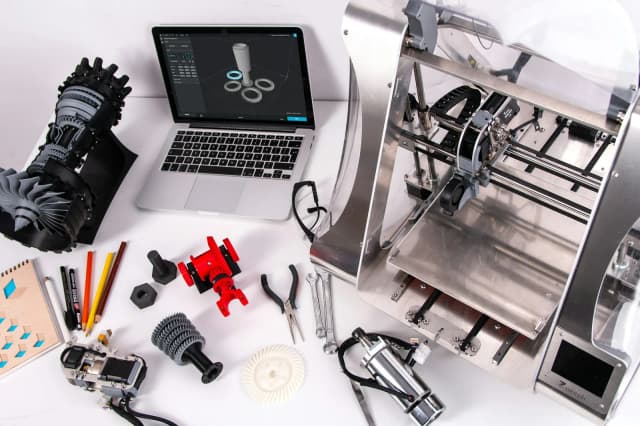
From digital model to physical part, without tooling
Validating a shape, testing a fit, or producing a few complex parts runs into the cost of preparing conventional manufacturing: programming and fixturing in machining, mold in injection. In small batches, this cost is not diluted.
3D printing starts from the file and deposits material by layers, so the geometry is not limited by tool access: internal channels, organic shapes, and integrated parts become possible. On the other hand, the result depends on the print orientation, which influences strength, finish, and precision in each direction.
Technosim's workflow covers the model source. If you only have the part, we scan it, reconstruct it in CAD (Scan-to-CAD) and print it. The mesh undergoes cleaning (closing, noise removal), gap compensation, and a final verification with a new scan. In practice, the prototype starts from the actual part and is delivered with verified dimensions.
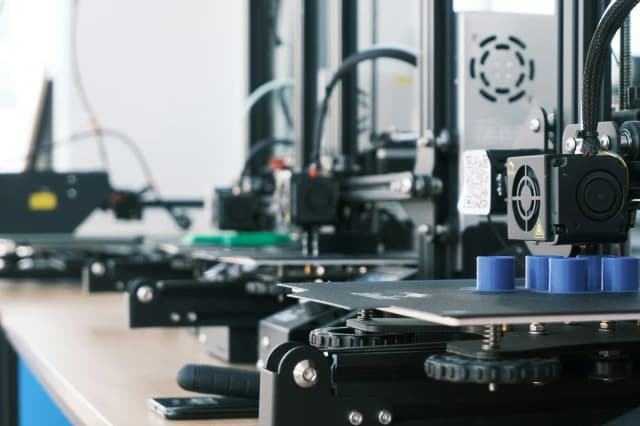
Why use 3D printing
No tooling
Without a mold, die, or machining program, validating a part does not require preparation investment.
Low-cost design iteration
Modifying the model and reprinting costs less than altering a mold, so shape errors appear in the prototype.
Complex geometries
Internal channels, organic shapes, and integrated parts that are difficult or infeasible to machine.
Small batches
The per‑part cost does not depend on amortizing tooling, which favors low‑volume production.
Replacement from scanning
Parts without a drawing become a mesh, CAD model, and printed part, without waiting for a supplier.
Dimensional inspection
The printed part can be scanned and compared to the model to confirm dimensions before use.
3D printing, machining, and injection molding: how to choose the route
| Criterion | 3D printing | Machining | Injection molding |
|---|---|---|---|
| Initial investment | Low | Medium (programming and fixturing) | High (mold) |
| First items | No tooling | Depends on programming | Depends on mold construction |
| Complex and internal geometry | Excellent | Limited by tool access | Limited by the mold |
| Cost per part at volume | High | Medium | Low |
| Small batches | Ideal | Good | Unfeasible |
| Design change | File swap | Reprogramming | Mold rework |
| Material properties | Depend on process and orientation | From raw material, uniform | From injected material |
How the work flows, from file (or part) to printed part
- 01
Model source
If you have the CAD, we use the file. If you only have the part, we scan it, reconstruct the model (Scan-to-CAD) and then print. A scanned mesh is printable when it is closed and noise‑free; to modify the part, a CAD model is required.
- 02
File verification
We check for a closed mesh (no holes), minimum wall thicknesses, holes, and fit clearances. We compensate the clearance between mating parts because the printed part has its own tolerance.
- 03
Orientation, material, and process
We define the print orientation and material based on load, temperature, surface finish, and quantity. Orientation affects strength and finish directionally. Available materials and processes are confirmed in the quotation.
- 04
Printing and finishing
We print, remove the supports, and perform the agreed finishing, from rough to more elaborate finishes.
- 05
Verification
When dimensions matter, we scan the printed part and compare it to the CAD model using a deviation color map. The result highlights process shrinkage or warpage, allowing model adjustments before running the next print.
3D printing services and equipment
- Reverse engineeringReconstruct the 3D model of a part without existing drawings and print the replacement.
- Scan-to-CADConvert the mesh into an editable CAD model before printing.
- 3D modelingFrom concept sketch to print-ready CAD model.
- 3DeVOK MT3D scanning with color and texture, ideal for full-color printing and presentation models. Exports ASC and STL.
Where 3D printing adds the most value
Functional prototypes
Form and fit testing before investing in tooling.
Replacement parts
Custom one-off components developed via reverse engineering, when the printing material meets the structural load requirements.
Jigs and fixtures
Manufacturing and assembly aids tailored to the actual scanned part.
Presentation models
Parts for design validation with clients or leadership.
Complex geometries
Internal channels and complex geometries that conventional machining cannot produce.
Industrial maintenance
Low-volume replacement parts for legacy machinery, produced directly from 3D scanning.
Factors affecting 3D printing cost and lead time
- Part size and volume.
- Printing material and technology.
- Surface finish, from as-printed to refined post-processing.
- Part quantity and required lead time.
- Model source: without existing CAD data, 3D scanning and modeling are required.
- Dimensional inspection: scanning the printed part and generating a deviation color map is an additional step.
- Support structures: parts requiring extensive supports consume more material and post-processing time.
How much does 3D printing cost and what to send for a quote
Pricing depends on volume, material, printing process, surface finish, and quantity, which is why quoting starts with the CAD file or the physical part. Small, simple parts cost less than large parts made from engineering-grade materials with advanced post-processing. If no CAD model exists, 3D scanning and reverse engineering are quoted separately.
Send the 3D model (STEP or STL) or photos and dimensions of the part, the quantity, intended application (mechanical stress, operating temperature, fluid contact), expected surface finish, and required lead time. Based on this, we recommend the optimal process, material, scope of work, and pricing.
Outsourcing 3D printing vs. investing in equipment: for prototypes and on-demand parts, service outsourcing eliminates the capital expense of machinery, raw materials, and dedicated operators. When choosing between 3D printing, machining, or injection molding, the rule of thumb is volume: low volumes and complex geometries favor additive manufacturing, while high volumes favor tooling. If you are unsure, we detail the alternative manufacturing routes in our quote.
Articles on this topic
- Resin Printer: How It Works, Which Is Best, How to Hire, and More!
- 3D Printer Resin: What It Is and How It Works
- PLA filament for 3D printing: types, uses, and limits
- Color 3D Printer: How It Works, Price, and Which Is Best
- 3D Food Printer: What It Is For and How It Works
- 3D Printer for Jewelry: How to Use, Materials, and Price
Frequently asked questions
What materials do you print?
Material and process are defined by the application: load, temperature, fluid contact, finish, and quantity. Describe the part’s use and we’ll recommend an option in the quote.
Do I need to have a 3D model?
No. If you only have the part, we scan and model it before printing.
Is it suitable for a final part?
In some cases, yes. We assess load, temperature, and environment and, for structural use, we validate the material before recommending printing.
Do you serve São Paulo and other states?
Yes, we serve all of Brazil. We provide 3D printing for companies in São Paulo, both the capital and the interior, and in any state. Technosim is located in Santo André, Greater São Paulo. We ship printed parts to any city.
What is the maximum part size?
It depends on the printing process. Provide the dimensions, and we will evaluate whether to print it in a single piece or as assembled sections.
Can a 3D-printed part replace the original one?
In many applications, yes. We evaluate mechanical loads, operating temperature, and environmental exposure. For structural use, we validate the material properties before recommending 3D printing, and the printed part can be 3D scanned for dimensional inspection.
Can you deliver the file to another manufacturer?
Yes. We deliver the CAD model and technical drawings in the format your manufacturer requires—such as STEP—so they can produce the part using the appropriate process.
How does a 3D-scanned part become a 3D-printed part?
The 3D scanner generates a point cloud or polygon mesh. To print, the mesh must be watertight and noise-free; to modify dimensions or compensate for wear, we reconstruct the CAD model (Scan-to-CAD). We then determine build orientation, tolerances, and material, print the part, post-process it, and inspect the finished piece by scanning it back against the CAD model.
How do I choose the right material for a 3D-printed part?
Based on the operating requirements: mechanical stress, working temperature, fluid exposure, UV/sunlight exposure, and desired surface finish. Provide these conditions, and we will recommend the best option. For structural applications, we validate material performance prior to recommending 3D printing. Available materials are confirmed in the quotation.
Is 3D printing cheaper than machining?
For one-off parts and complex geometries, generally yes. For simple geometries in higher volumes, machining is usually more cost-effective. We can compare both manufacturing options in the quote.
What is the accuracy of a 3D-printed part?
It depends on the additive process, material, build orientation, and part size. Every 3D printing process has inherent tolerances and may exhibit shrinkage or warpage. For critical components, we 3D scan the printed part and compare it to the CAD model, revealing the actual dimensional deviations.
When should I outsource 3D printing rather than buying equipment?
When demand is sporadic or project-based: prototypes and one-off parts eliminate the need for in-house machinery, raw materials, and dedicated operators. If your workflow involves frequent 3D scanning, purchasing an industrial 3D scanner—which Technosim distributes—may be worthwhile. Tell us about your typical part workflow, and we will advise on the best approach.
What determines the lead time for 3D printing?
Part size, material, printing process, quantity, post-processing requirements, and whether pre- or post-scanning inspection is needed. Parts requiring extensive support structures or fine surface finishing involve additional processing stages. The lead time is provided in the proposal upon reviewing your CAD file.
Do you need a prototype or a printed part?
Send the model or describe the part, its use, and quantity. We’ll reply with options and lead time.