
PLA filament for 3D printing: types, uses, and limits
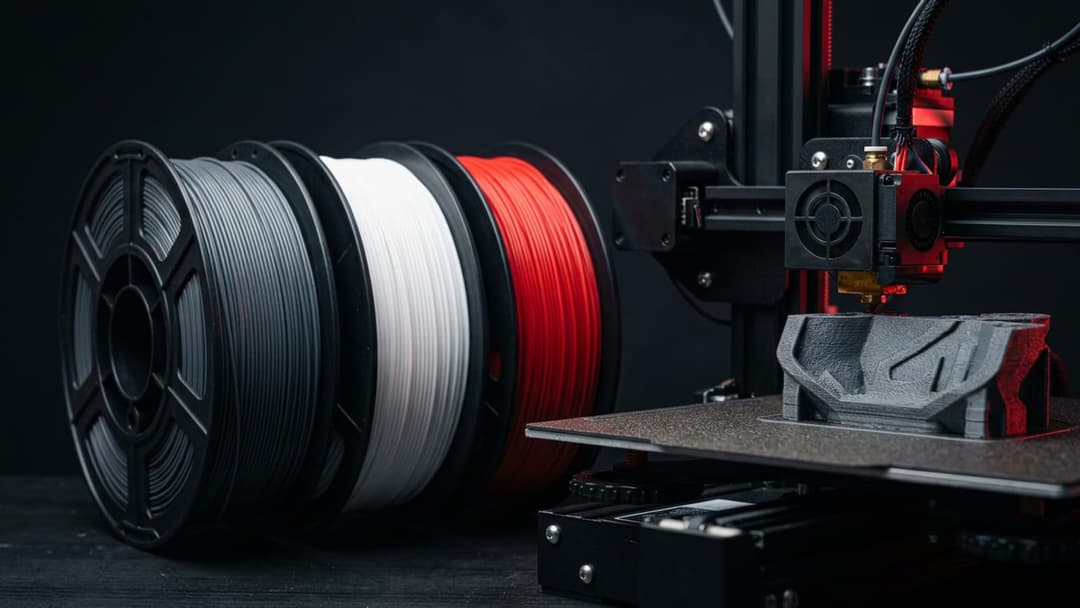
PLA (polylactic acid) is the most widely used filament in extrusion 3D printing. The main types are standard PLA, PLA+ with higher impact resistance, PLA with fillers such as wood or fibers, and finish PLA, such as silk or matte. All have low heat resistance.
What is PLA filament?
PLA is a thermoplastic produced from plant-based sources, such as corn starch and sugarcane. It belongs to the polyester family and is classified as biodegradable under industrial composting conditions. This does not mean that a PLA part degrades on its own in normal use or in ordinary trash.
Its popularity comes from practical properties. It softens at a relatively low temperature, shrinks little as it cools, does not usually require a very hot bed or an enclosed chamber, and rarely warps. The result is a predictable print, with good detail on edges and surfaces.
What are the types of PLA filament?
Standard PLA
This is the basic version, rigid and brittle. It prints with good definition and is suited to visual models, form prototypes, and assembly tests.
PLA+ (modified PLA)
It receives additives to improve toughness and reduce brittleness. The composition varies between manufacturers, so the name does not guarantee a specific property. In general, it better withstands snap fits and light loads. Check the datasheet of the material you buy.
Finish PLA (silk, matte, dual-color)
It changes the part's appearance: satin gloss, matte surface, or color transition. It is an aesthetic choice for presentation models.
Filled PLA
It mixes particles of wood, metal powder, fibers, or other materials into the PLA. It changes the look and, in some cases, the stiffness. Abrasive fillers wear down brass nozzles and may require a hardened steel nozzle.
High-speed PLA and engineering PLA
Formulas adjusted to flow well at higher speeds or to resist higher temperatures after heat treatment. The gains depend on the formula and the process, and the manufacturer's guidance should be followed.
What is PLA used for in industry?
On the factory floor, PLA is good for parts that are not exposed to heat, continuous load, or solvents. Concrete examples:
- Form models to validate the fit of an assembly before machining.
- Lightweight gauges and checking fixtures for bench use.
- Prototypes for customer presentation.
- Replicas printed from a 3D scan, for studying geometry or positioning.
- Low-load holders and organizers.
For functional parts in continuous use, PLA tends to be limited.
What is the difference between PLA and ABS?
ABS tolerates more heat and is more impact resistant, but is harder to print. It shrinks as it cools, warps easily, requires a heated bed and, preferably, an enclosed chamber and ventilation, since it releases fumes during printing. PLA is simpler to print and gives better definition, but it softens at lower temperatures and breaks with less deformation.
A PLA part left inside a vehicle in the sun, for example, can deform. If the part must withstand operating heat, ABS or other materials, such as PETG and nylon, are more suitable, each with its own limits. For use in a heated environment, consult the material's datasheet.
What is the strongest filament?
It depends on the type of strength. For impact, nylon and polycarbonate tend to outperform PLA. For stiffness, carbon fiber- or glass-reinforced filaments stand out. For heat, there are engineering materials that PLA cannot match. Beyond the material, the strength of a printed part depends on orientation, infill, number of walls, and layer adhesion, which is usually the weakest point.
How do you choose the right filament?
- Define the function: purely visual, test fit, or working part.
- Check the part's operating temperature.
- Consider mechanical loads and impacts.
- Consider the required finish and precision.
- Check compatibility with your printer, including nozzle and maximum temperature.
Store the filament in a dry place. PLA absorbs moisture, which causes bubbles, stringing, and a rough surface in the print.
Which print settings affect the result with PLA?
Beyond the filament type, four parameters define quality. Nozzle temperature affects layer adhesion: too low makes the part brittle, too high causes stringing and loss of detail. Part cooling improves bridges and fine edges. Layer height controls the finish and the print time. Infill and the number of walls determine strength. The right values vary with the brand and the printer, so print a temperature tower with each new spool and follow the range recommended by the manufacturer.
Frequently asked questions
Is PLA+ always stronger than regular PLA?
It is generally tougher, but the term is not standardized. Compare the manufacturers' datasheets.
Can PLA withstand heat?
Not very well. It softens at much lower temperatures than ABS or nylon and should not be used where there is operating heat or exposure to sun inside enclosed spaces.
Is PLA suitable for functional parts?
For light loads and use at room temperature, yes. For continuous stress or heat, choose another material.
Can a scanned part be printed in PLA?
Yes. After scanning and mesh cleanup, the model is printed. For functional use, evaluate whether PLA meets the part's conditions.
Is PLA food safe?
The material itself may be food grade, but the printed part has layers and pores where residue can lodge. Avoid contact with food unless technical guidance says otherwise.
How to request a 3D printing quote
Send the 3D model or the part to be scanned, the quantity, the function of the part, and the temperature and loads it will be exposed to. Technosim recommends the right process and material and sends the quote. Learn about our 3D printing service and read more on the blog.