
Volumetric Data Extraction from Ore Stockpiles
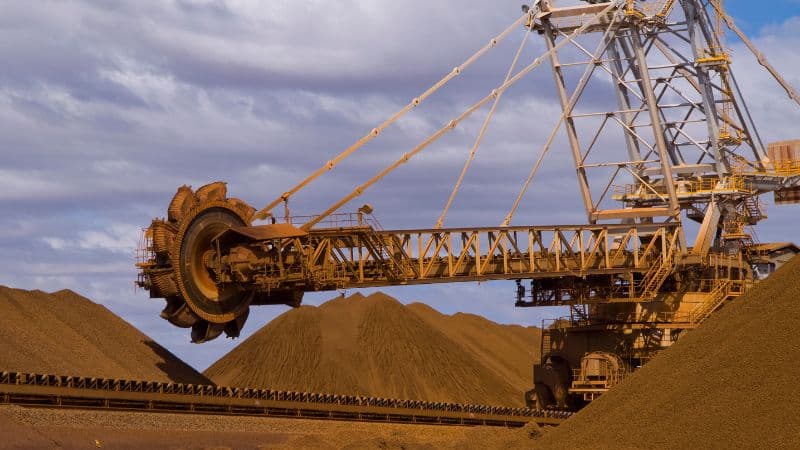
To measure the volume of ore stockpiles, the pile is scanned in 3D, by laser or by drone photogrammetry, and the software calculates the volume from the captured surface. The method is faster, safer, and more accurate than traditional surveying.
The mining industry is constantly looking for new ways to improve efficiency and productivity.
With advances in technology, new tools have emerged that can extract precise and detailed data, enabling a more complete understanding of ore stockpiles. This is where Reverse Engineering comes in.
Reverse Engineering is an approach that aims to uncover how an object or system works and how it is structured, by analyzing its characteristics and behaviors.
In this context, it can be applied to ore stockpiles, uncovering the distribution and density of the material.
By collecting data, it is possible to obtain valuable information about the stockpile's profile, its stability, and even to identify potential failure points.
Collecting this volumetric data can be a challenge. This is where 3D Printing comes in. With this technology, it is possible to create accurate replicas of ore stockpiles, at reduced scale, for analysis and study.
These replicas allow tangible visualization and make it easier to analyze the collected data.
Through 3D Printing, it is possible to create physical models of ore stockpiles, faithfully reproducing their shapes and structures. These models can be used for tests and simulations, allowing engineers and geologists to explore different scenarios and make decisions based on concrete information.
In addition, these 3D-printed models can be shared among multidisciplinary teams, promoting collaboration and the joint development of innovative solutions.
By combining Reverse Engineering with 3D Printing, a vast field of possibilities opens up for the mining industry.
Analyzing volumetric data on ore stockpiles allows more efficient resource management, minimizing losses and optimizing processes.
In addition, creating 3D-printed models eases communication among the professionals involved, speeding up decision-making and fostering innovation.
The extraction of volumetric data from ore stockpiles is a promising field that unites Reverse Engineering and 3D Printing. Together, these technologies provide accurate information on the characteristics of the stockpiles, promoting smarter and more efficient management in the mining industry.
The Importance of Reverse Engineering in Volumetric Data Extraction
The mining industry is always looking for ways to improve its processes, increase efficiency, and boost productivity. This is where Reverse Engineering proves to be a powerful tool.
By applying this approach to ore stockpiles, engineers and geologists can uncover their structure and understand how they work by analyzing their characteristics and behaviors.
Reverse Engineering enables the collection of accurate and detailed data on ore stockpiles, revealing information vital to optimizing the extraction process.
Through this thorough analysis, it is possible to gain a complete understanding of the distribution and density of the material, making it possible to identify points of interest and even potential failure areas.
This information is essential for efficient and safe management of mining operations.
The Role of 3D Printing in Volumetric Data Analysis
While Reverse Engineering uncovers the secrets of ore stockpiles, 3D Printing plays a crucial role in analyzing and visualizing this data. 3D Printing technology allows the creation of accurate physical replicas of ore stockpiles, at reduced scale, making it easier to understand and study their structure.
By 3D printing models of ore stockpiles, engineers and geologists can hold a tangible, physical representation of the material in their hands.
These 3D-printed models not only provide a more concrete visualization but can also be used for tests and simulations. With them, it is possible to explore different scenarios, analyze the stability of the stockpiles, and make decisions based on concrete information.
Combining Reverse Engineering and 3D Printing in Mining
By combining Reverse Engineering with 3D Printing, the mining industry opens up a wide range of possibilities. Analyzing volumetric data on ore stockpiles allows more efficient resource management, minimizing losses and optimizing extraction processes.
With 3D-printed models, it is possible to share knowledge among multidisciplinary teams, promoting collaboration and the joint development of innovative solutions.
The combination of Reverse Engineering and 3D Printing in mining also brings significant safety benefits. By analyzing and physically reproducing ore stockpiles, it is possible to identify potential areas of instability or risk, allowing preventive measures to be taken before accidents or collapses occur.
The ability to test different scenarios on 3D-printed models makes it possible to run simulations and risk assessments, contributing to a safer work environment for the professionals involved in mineral extraction.
In addition, applying Reverse Engineering and 3D Printing in mining has the potential to drive innovation and the development of new solutions.
By analyzing ore stockpiles in detail and creating 3D-printed models, opportunities arise to identify patterns, improve existing processes, and even develop new extraction techniques. This innovative approach can result in greater efficiency, reduced costs, and more sustainable mineral exploration.
It is important to stress that extracting volumetric data from ore stockpiles through Reverse Engineering and 3D Printing does not replace the traditional monitoring and analysis practices carried out by the mining industry.
These complementary technologies add value by offering a new perspective and greater accuracy in understanding the characteristics of ore stockpiles.
In short, extracting volumetric data from ore stockpiles using Reverse Engineering and 3D Printing represents a significant advance for the mining industry.
These technologies enable more detailed analysis, concrete visualization of data, and efficient collaboration among teams. With them, it is possible to make decisions based on accurate information, improve operational efficiency, and drive innovation in the mining industry.
As technology continues to evolve, it is exciting to imagine how Reverse Engineering and 3D Printing can continue to transform mining.
Through these approaches, the industry can move toward more sustainable, safe, and efficient processes, ensuring a more responsible use of natural resources and contributing to a more prosperous future.