
Industrial Automation
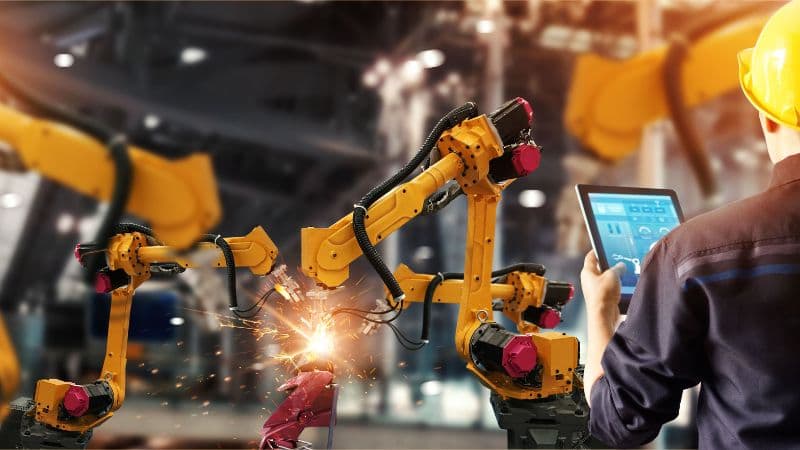
Industrial automation is the use of sensors, controllers (PLCs), robots, and software to operate machines and processes with minimal human intervention. It increases productivity, quality, and safety. Below, we cover the types of automation, applications, and benefits.
What Is Industrial Automation?
Industrial automation therefore refers to the application of systems and technologies to control and operate production processes, machines, and systems in industrial environments. These systems can range from simple sensors that monitor temperatures to fully automated production lines in factories, depending on the desired level of complexity.
The goal of industrial automation is therefore to increase efficiency, improve product quality, reduce waste, and provide a safer working environment. It involves replacing manual tasks with machines, implementing automated control systems, and integrating information and communication technologies (ICT) to optimize, in this way, the operation of industrial facilities.
How Does It Work?
Industrial automation works through the integration of hardware and software that, in turn, control operations and processes in an industrial environment. Thus, the key components of the automation system include:
- Sensors: These are devices that, by collecting data about the environment, such as temperature, pressure, and speed, provide essential information to the system.
- Programmable Logic Controllers (PLCs): These are industrial computers that run custom programs to control specific machines and processes.
- Actuators: These are devices that carry out actions based on the information received from both the sensors and the PLCs.
- Communication Networks: They facilitate the exchange of information between system components, thereby enabling efficient coordination and control.
- Control and Supervision Software: These are applications that allow detailed programming, monitoring, and control of industrial processes.
- System Integration: Integrating automation systems with production management systems (MES) and enterprise systems (ERP) is crucial for process synchronization and resource planning.
In this way, the automation system operates on the basis of algorithms and programmed logic, which are used to perform specific tasks. This results in the automation of industrial processes, while performance is constantly monitored through the sensors. In addition, the actuators respond to the information provided by the sensors, making decisions and making changes in real time to maintain control of the process.
Applications
Industrial automation has a wide range of applications in various sectors, including:
- Automotive Industry: Automation of assembly lines, industrial robotics, and quality control.
- Food Industry: Automation of production, packaging, and logistics processes.
- Pharmaceutical Industry: Drug manufacturing, quality control, and product tracking.
- Chemical Industry: Production processes, chemical mixing, and reaction control.
- Oil and Gas Industry: Refinery control, automated drilling, and environmental monitoring.
- Energy: Automation of power plants, power distribution, and process control.
- Additive Manufacturing (3D Printing): Automation of industrial 3D printers.
- Logistics and Warehousing: Warehouse automation, automated transport systems, and robotics in logistics.
Benefits of Industrial Automation
Industrial automation offers a number of significant benefits for companies, including:
- Increased Efficiency: Automation enables faster, more precise, and more consistent production, reducing downtime and waste of resources.
- Improved Quality: Automation ensures greater control over production processes, resulting in higher-quality products.
- Cost Reduction: Automation reduces dependence on labor, saves energy, and minimizes errors.
- Safer Working Environment: You can automate many hazardous tasks, which makes the workplace safer for employees.
- Flexibility and Adaptability: Automation systems can be reconfigured and adapted to meet changes in production demands.
- Data Collection and Analysis: Automation generates real-time data that you can use to analyze and make informed decisions
- Market Competitiveness: Companies that adopt automation are better positioned to compete in the global market.
Steps of the process
The industrial automation process involves several interconnected steps. Here are the key steps:
- Analysis and Planning: The first step involves analyzing production processes and identifying opportunities for automation. In this phase, the objectives and requirements of the automation system are defined.
- Engineering Design: Automation engineers develop the design, which includes selecting sensors, actuators, PLCs, and other components, as well as developing the control software.
- Implementation: At this stage, the automation system is built and installed at the industrial plant. This includes assembling the hardware, programming the PLCs, and installing the communication networks.
- Testing and Commissioning: After implementation, the system is tested to make sure it meets the requirements and works correctly. Any problems or necessary adjustments are identified and resolved.
- Training and Operation: Operators and technicians receive training to operate and maintain the automation system. This includes using the control software and troubleshooting.
- Maintenance and Updates: Ongoing maintenance of the system is crucial to keep it running efficiently. In addition, updates may be needed to incorporate new technologies or improvements.
How does simulation software make a difference in the Industrial Automation process?
Using simulation software plays a key role in the industrial automation process, because it allows the system to be analyzed, tested, and optimized before physical implementation. In addition, simulation software makes a difference in several ways, making it easier to detect problems and necessary adjustments before the implementation phase. Here are some specific ways in which simulation software contributes significantly to project success:
- Early Design and Validation: Before physically building the automation system, engineers can use simulation software to design and validate it. This helps identify errors and optimize the design before investing in hardware.
- Operator Training: Simulation software can be used to train operators in a virtual environment. This allows them to become familiar with the system and learn to operate it safely.
- Testing Diverse Scenarios: Engineers can run tests across multiple scenarios to ensure the system works reliably under different conditions. This is particularly important in critical applications, such as industrial process control.
- Saving Time and Resources: Simulation helps identify problems and make adjustments before physical implementation, saving significant time and resources.
- Continuous Improvement: After implementation, simulation software remains valuable for continuously improving the system, allowing adjustments and optimizations based on real performance data.
Reverse engineering is another important aspect of industrial automation: creating digital models from existing physical components.
In addition, 3D scanning and simulation software often support this process. With this technology, you can analyze and optimize systems that are already in operation.
Click here to learn more about Technosim Engenharia