
Forging
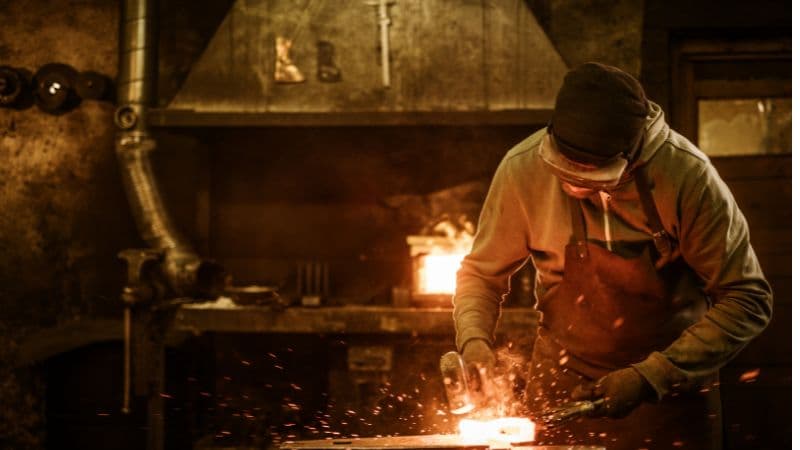
Forging is the forming process that shapes metal by compression, with a hammer or press, hot or cold. It produces high-strength parts, such as connecting rods, crankshafts, and flanges. Below, we cover the types of forging, applications, and the most common defects.
What Is Forging?
Forging is a mechanical forming process that involves changing the shape of a material through the application of compressive forces. The material is heated to a suitable temperature to make it malleable and is then shaped by compression between dies, which are specific molds. The result is a part with high strength and durability, ideal for applications that require exceptional mechanical properties.
Main Types of Forging
There are several types of forging, each with its own specific characteristics:
- Hammer Forging: In this method, a hammer repeatedly strikes the material, shaping it to the dies. Hammer forging is widely used in the production of small to medium-sized forged parts.
- Press Forging: In press forging, compression is applied by hydraulic or mechanical presses. This method is best suited to larger, complex parts that require high precision.
- Open-Die Forging: In this process, the material is compressed between flat dies, which is common in the manufacture of plates and discs.
- Hot Impression-Die Forging: Involves deforming the material in a closed die, and is suitable for mass production of parts with complex shapes.
Applications of Forging
Forging is widely used in many industries because of its exceptional mechanical properties. Some of the main applications include:
- Automotive Industry: Forged parts, such as crankshafts and axles, give vehicles high strength and durability.
- Aerospace Industry: Aerospace components, such as gears and structures, are often produced by forging to withstand extreme conditions.
- Oil and Gas Industry: Equipment used in challenging environments, such as drill bits, benefits from forging to ensure corrosion resistance and high durability.
- Construction: Metal structures and steel beams are often produced by forging because of its robustness.
- Shipbuilding Industry: Ship components, such as anchors and shafts, are made by forging to withstand harsh marine conditions.
Innovations in Forging
Traditional forging has evolved with the advent of advanced technologies. The use of software simulations, such as 3D scanning and reverse engineering, has made it possible to optimize the forging process.
Engineers can anticipate material behavior, identify areas of stress and deformation, and refine the process before production. This saves time and resources, while also improving the efficiency and quality of forged parts.
In addition, high-performance materials, such as titanium alloys and special steels, are being developed to meet the demands of modern industries. The search for sustainable solutions has also led to the development of cold forging techniques, which reduce material waste and energy consumption.
How does the Forging process work?
The forging process is a technique that seeks to shape materials through the application of compressive forces. First, the material is heated to a suitable temperature to make it malleable. It is then placed between specific dies or molds.
The application of mechanical force causes the material to take the desired shape. The high temperature at the start of the process allows plastic deformation of the material, which means it can be shaped without breaking. This method is very effective at producing parts with high strength and durability, suited to critical applications.
Steps of the Forging process
The forging process can be divided into several essential steps:
- Material Preparation: In this phase, the starting material is selected and prepared. This usually involves heating the material to a suitable temperature to make it malleable.
- Application of Mechanical Force: The material is then placed between dies and mechanical force is applied to shape it. This process can be carried out through hammer forging, press forging, open-die forging, or other methods, depending on the part's specifications.
- Cooling or Heat Treatment: After forming, the material may go through a controlled cooling process or heat treatment to optimize its mechanical properties.
- Finishing and Inspection: Forged parts may go through finishing processes, such as machining, cutting, or polishing, and are inspected to make sure they meet quality specifications.
How does simulation software make a difference in the Forging process?
The incorporation of simulation software, including the use of 3D scanning and reverse engineering, is revolutionizing the forging process. These tools allow engineers to predict material behavior during forming, identifying areas of stress, deformation, and potential defects.
3D scanning is used to digitize real parts and create virtual models, which can be optimized before production. This saves time and resources, reducing the need for testing and adjustments in actual production.