
3D Printers in Medicine
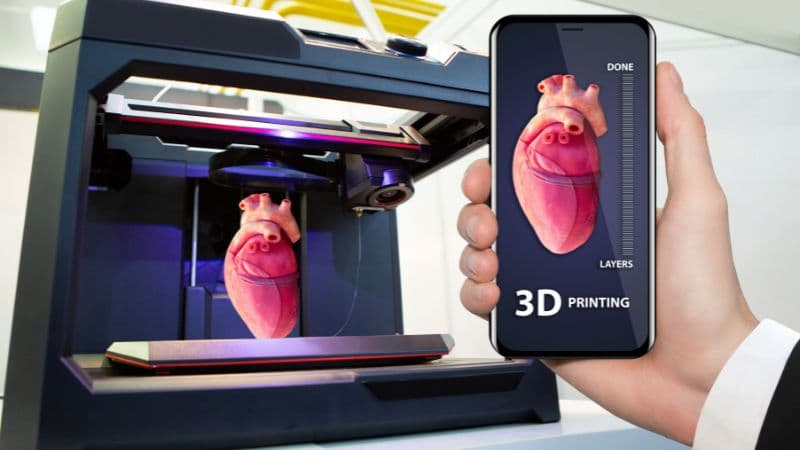
In medicine, the 3D printer produces anatomical models for surgical planning, surgical guides, prostheses, orthoses, and custom implants, based on a CT scan or the patient's 3D scan.
At the heart of this revolution is the 3D scanning process, a technique that allows us to capture minute details of human anatomy accurately and in three dimensions.
Imagine being able to faithfully reproduce complex structures of the human body, from bones to organs, through meticulous scanning.
This 3D scanning technology makes it possible to create incredibly detailed digital models, which serve as the foundation for the wonders of 3D Printing in Medicine.
A 3D printer in medicine is much more than a mere technology trend. It is a tool that transcends the boundaries of imagination, making it possible to create precise physical models from the digital models generated by 3D scanning.
Imagine surgeons holding identical replicas of a specific patient's organs, allowing them to study the unique anatomy before a delicate operation.
With the help of 3D printing, healthcare professionals can prepare better, refining surgical techniques and reducing the risks involved.
In addition, 3D printing is revolutionizing the production of custom prostheses and implants. Imagine a scenario where a prosthesis can be shaped to fit exactly the unique dimensions of a patient.
Or even one where an implant can be custom designed to replace a damaged bone, providing a faster and more effective recovery. 3D printing is turning dreams into reality, offering solutions that were unthinkable a few decades ago.
We cannot fail to mention the rapid evolution of 3D printing in medicine in fields such as dentistry, where dental prostheses, crowns, and even orthodontic appliances can be customized with millimeter precision.
And when it comes to research and teaching, 3D printing allows the creation of anatomical models for students and medical professionals, improving the practical understanding of human anatomy.
This is an exciting time in the history of medicine. The marriage of 3D scanning and 3D printing is delivering groundbreaking advances, making treatments more personalized and effective, and fundamentally changing the way we look at human health and well-being.
Get ready to explore the wonders this technological combination is bringing to medicine, and the transformative impact it will have on the lives of patients and professionals in the field.
How does 3D printing work in medicine?
The process of 3D printing in medicine is remarkable: layers of material are deposited one on top of another, guided by precise three-dimensional models.
In the medical context, the process starts with 3D scanning, which captures a detailed image of the patient's anatomy or the desired medical object.
This digital model is then processed and sent to the 3D printer, which begins building the structure in layers, using biocompatible materials or, in some cases, even living cells.
The result is an accurate replication of the anatomy, enabling everything from custom prostheses to the manufacturing of artificial organs.
What is a 3D printer used for in medicine?
The 3D printer has countless applications in medicine, from creating custom prostheses and implants to producing anatomical models for educational and surgical training purposes.
It is also used to manufacture medical devices, such as orthopedic braces, surgical guides, and specialized instruments, that fit patients' individual needs perfectly.
What are the benefits of 3D printing in medicine?
3D printing in medicine offers a series of revolutionary benefits. It enables unprecedented customization, ensuring that each treatment is adapted to the patient's unique characteristics.
In addition, it reduces manufacturing and production time, shortening wait times and speeding up medical procedures.
3D printing also enables a less invasive approach in many cases, improving recovery and reducing the risks associated with complex surgeries.
How does 3D bioprinting work?
3D bioprinting is an advanced branch of 3D printing in medicine, in which not only synthetic materials are used, but also living cells.
In this process, the cells are embedded in a specialized support material called “bioink,” which provides an environment conducive to cell growth.
The 3D printer deposits layers of bioink containing cells, enabling the creation of three-dimensional tissues. This opens the door to manufacturing functional tissues and organs in the lab, with applications ranging from pharmaceutical testing to the eventual production of replacement organs.
What is 3D organ printing?
3D organ printing is one of the most promising applications of 3D printing in medicine. This technique involves creating functional artificial organs from living cells and biomaterials.
Although it is still at an experimental stage, the idea is to use the properties of 3D bioprinting to create custom-made organs for patients who need transplants.
This has the potential to eliminate long donor waiting lists and reduce the risk of rejection, since the organs would be created from the patient's own cells.
3D printing is redefining the medical landscape in unimaginable ways. From customizing treatments to manufacturing complex tissues, this technology is enabling advances that could improve the lives of millions of people around the world.
With constant evolution and ongoing research, 3D printing in medicine is a fascinating journey that continues to surprise and inspire.